
how it works
A daily Burst from the cab. An alert to the manager who can fix it.
No new app. No new device. No surveys to ignore. Road Pact lives inside the workflow drivers are already doing, and turns one quick touchpoint into the earliest visibility you can get into a driver’s intent to stay or leave.
Drivers respond in 15-30 seconds, same as any other in-cab message.
At end of shift, the Road Pact prompt appears on the in-cab tablet drivers already use. A thumbs up or thumbs down. An optional tap on what got in the way: fatigue, dispatch clarity, schedule predictability, pay clarity, truck condition. An optional comment.
That’s it. No login. No new training. No new hardware. The whole interaction takes under a minute.
Why workflow integration matters.
Surveys assume drivers will stop what they’re doing to provide feedback. Most don’t. Road Pact assumes the opposite. The only feedback worth designing for is the kind drivers can give without slowing down. A daily Burst takes 15-30 seconds and gets done.

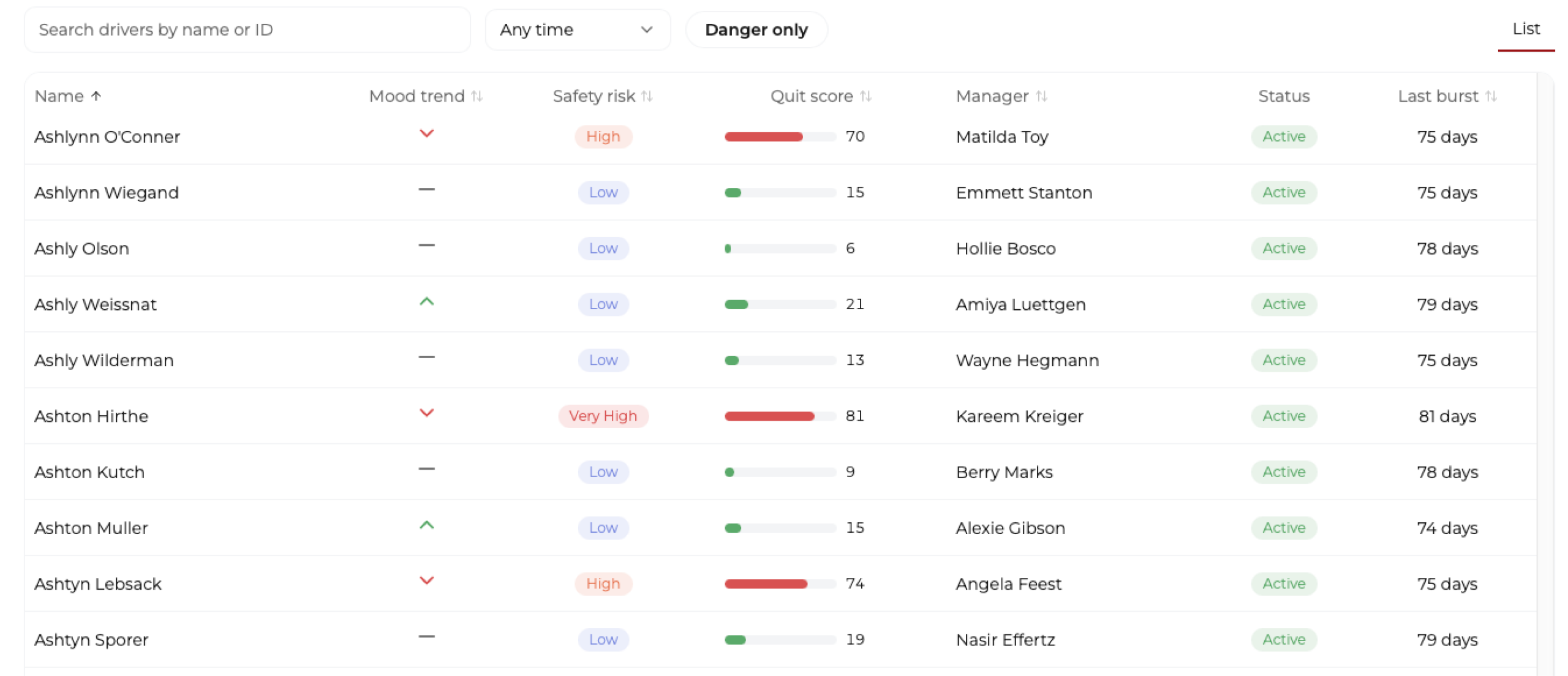
The pattern is what matters, not the bad day.
Every driver has their own baseline. Bianka’s normal is different from Rolando’s. One rough Tuesday is noise. Recurring frustration that builds over weeks is what we surface.
The platform tracks directional change in measurable operational behavior over time. Recurring dispatch friction. Repeated equipment complaints. Schedule volatility that stops being mentioned because the driver has given up on it being fixed. A sustained pattern surfaces as an alert. A single bad day does not.
- Per-driver baselines, recalibrated continuously
- Friction tags rolled up across drivers, routes, terminals
- Quit-risk score with engagement trend overlay
- Industry-benchmark comparison for context
Every alert routes to a named manager, not a queue.
Road Pact knows who owns each driver relationship inside your fleet. When a pattern crosses the threshold, the alert goes to that person, with context. Which driver. What pattern. How long it’s been building.
What happens next is a five-minute conversation, not an HR escalation. Road Pact surfaces what drivers are telling you. The relationship does the rest.
What Road Pact does not do.
We can’t fix pay, home time, or lane assignments. We hear those issues earlier so the people who can fix them have the information they need to act. Road Pact is a real-time driver feedback loop that gets what drivers are telling you to the right person before a good driver walks out the door.

What actually happens after an alert.
An alert that nobody acts on is just notification fatigue. The Follow-through workflow is built into the platform because what happens after the alert is more important than the alert itself.
01 · REVIEW WITH CONTEXT
The manager opens the alert.
Driver name, the pattern that crossed the threshold, the friction categories involved, recent comments in the driver’s own words, and how long the pattern has been building. The alert exists to inform a five-minute decision, not to replace it.
02 · CHOOSE THE RESPONSE
A specific operational action.
A conversation with the driver. A review of recent dispatch interactions. A route or lane adjustment. Coordination with maintenance on a recurring equipment issue. A pay-clarity audit. Or marking the alert as a false positive. The action is documented inside the platform.
03 · LOG WHAT WAS DONE
Intervention captured.
What action was taken, when, and by whom. This is the record that makes the next two months legible. Without it, the same friction pattern will surface again in three weeks and nobody will remember whether it was addressed.
04 · TRACK THE OUTCOME
Did the pattern change?
Over the two to four weeks following the intervention, the platform watches whether the operational pattern improves, holds steady, or continues to compound. That feedback informs whether the action worked, whether another conversation is needed, and which interventions are most effective for which friction types over time.
Road Pact does not script the intervention. Pay, home time, dispatcher friction, lane assignments, equipment, and driver relationships are all operational levers fleet managers already know how to pull. The platform exists to make sure the right manager sees the right pattern early enough to pull them.
COMMON INTERVENTIONS BY friction TYPE
What managers actually do with the alert.
Road Pact does not prescribe a response. What follows are common operational actions fleet managers take when the platform surfaces a specific friction pattern. The right action depends on the driver, the fleet, and the manager’s judgment.
IF "DISPATCH CLARITY" OR "ROUTE CHANGES" RECUR
Operational coordination.
- Review recent dispatch interactions with the driver
- Audit the dispatcher's communication pattern across drivers
- Schedule a coordination conversation if a recurring conflict is the cause
- Reassign to a different dispatcher if the relationship has broken down
IF "SCHEDULE PREDICTABILITY" RECURS
Schedule and home-time review.
- Review recent route assignments for last-minute changes
- Identify whether the volatility is systemic on that lane
- Audit home-time adherence for the past 30 to 60 days
- Coordinate with operations on a more stable scheduling pattern
IF "TRUCK CONDITION" OR MAINTENANCE ISSUES RECUR
Equipment escalation.
- Escalate the specific equipment issues mentioned in driver comments
- Review the maintenance history for that asset
- Coordinate a unit swap if the truck is at end of life
- Document the issue trail for parts ordering and shop scheduling
IF "PAY CLARITY" RECURS
Compensation review.
- Audit the driver's recent settlements line by line
- Walk the driver through the breakdown in a one-on-one
- Verify the driver's pay structure matches their lane assignment
- Coordinate with payroll on any recurring miscalculation
IF "MANAGER SUPPORT," LONELINESS, OR WELLNESS TAGS RECUR
Personal follow-up.
- Manager initiates a direct check-in conversation
- Coordinate with HR on wellness resources available to the driver
- Adjust to ensure regular terminal time with peers
- Review whether route assignment is contributing to isolation
IF THE ALERT IS A FALSE POSITIVE
Tag and tune.
- Manager marks the alert as a false positive with context
- Common cause: a temporary external event (weather, family emergency)
- The platform learns from the tag and adjusts threshold sensitivity
- Not every alert leads to an intervention. That is by design.
Road Pact helps managers intervene earlier. The platform’s job is to surface patterns before they would be visible through normal channels, then get out of the way. Managerial judgment owns the call. Fleet operators have years of operational instinct.
the window to act
Most fleets see it at week 13. With a daily Burst, you can hear it by week 5.
A driver’s decision to leave typically solidifies four to eight weeks before active job searching begins. Most fleets have no way to hear what drivers are telling them in that window. By the time the data shows up, the decision is locked in.
Modeled window based on Road Pact’s pattern-recognition methodology. The broader research literature supports that recurring frustration builds over weeks before a driver begins actively searching. Actual outcomes vary by fleet.
Schedule stress, equipment frustration, route inefficiency.
Easy to dismiss as noise. Road Pact starts logging the pattern.
Dispatch friction, pay concerns, home time pressure.
Frustration starts compounding. The pattern crosses the threshold. A named manager gets an alert. There are weeks of intervention window remaining.
Lower engagement, minimal effort, active job search.
The decision is forming. Intervention is still possible but harder.
Notice given. Exit interview.
Most fleets find out here. The cost is already locked in.
deployment
Live within 2 business days. No IT support required.
Road Pact deploys through your existing mobile device management. The app pushes to in-cab tablets the same way any approved fleet app reaches your drivers today. No new hardware, no driver-facing rollout, no IT involvement. Available in the Platform Science Marketplace.
Runs on what you have
Road Pact deploys to in-cab devices already in your fleet through your existing mobile device management system. If your drivers can receive a dispatch message, they can complete a daily Burst. No new device procurement, no driver-facing rollout, no IT involvement.
Routed to your people
Map your existing manager-to-driver relationships once. Every alert goes to the person who already owns that driver. Not a help-desk queue. Not a generic distribution list.
Works alongside what you've got
Road Pact doesn’t replace your telematics platform, your TMS, or your HR system. It fills the gap none of them were built to fill: a real-time read on what drivers are experiencing.
Hear what your drivers have been telling you.
A 30-minute conversation about how Road Pact would integrate with how your fleet already operates. Qualified fleets may be eligible for a 30-day pilot after the walkthrough.