Road Pact

the platform

Two sides of the same signal.

In the cab, drivers give one quick response a day. In the office, fleet leaders see the patterns build in real time. The dashboard updates the moment a driver responds.

15 seconds. No new app.

At end of shift, the Road Pact prompt appears on the same in-cab device drivers use to receive dispatch messages. Thumbs up or thumbs down. An optional tag on what got in the way. An optional typed comment. Same routine, every day.

This is the entire driver-facing experience. There is no app to download, no separate login, no portal to remember. If a driver can read a dispatch message, they can use Road Pact.

WHY THIS IS DIFFERENT

Surveys ask drivers to stop working and provide feedback. Most won’t. Road Pact takes the opposite approach. The only signal worth designing for is one drivers can give without breaking stride. That’s why response rates stay high after week one, when survey fatigue usually sets in.

The dashboard, built for the questions fleet leaders actually ask.

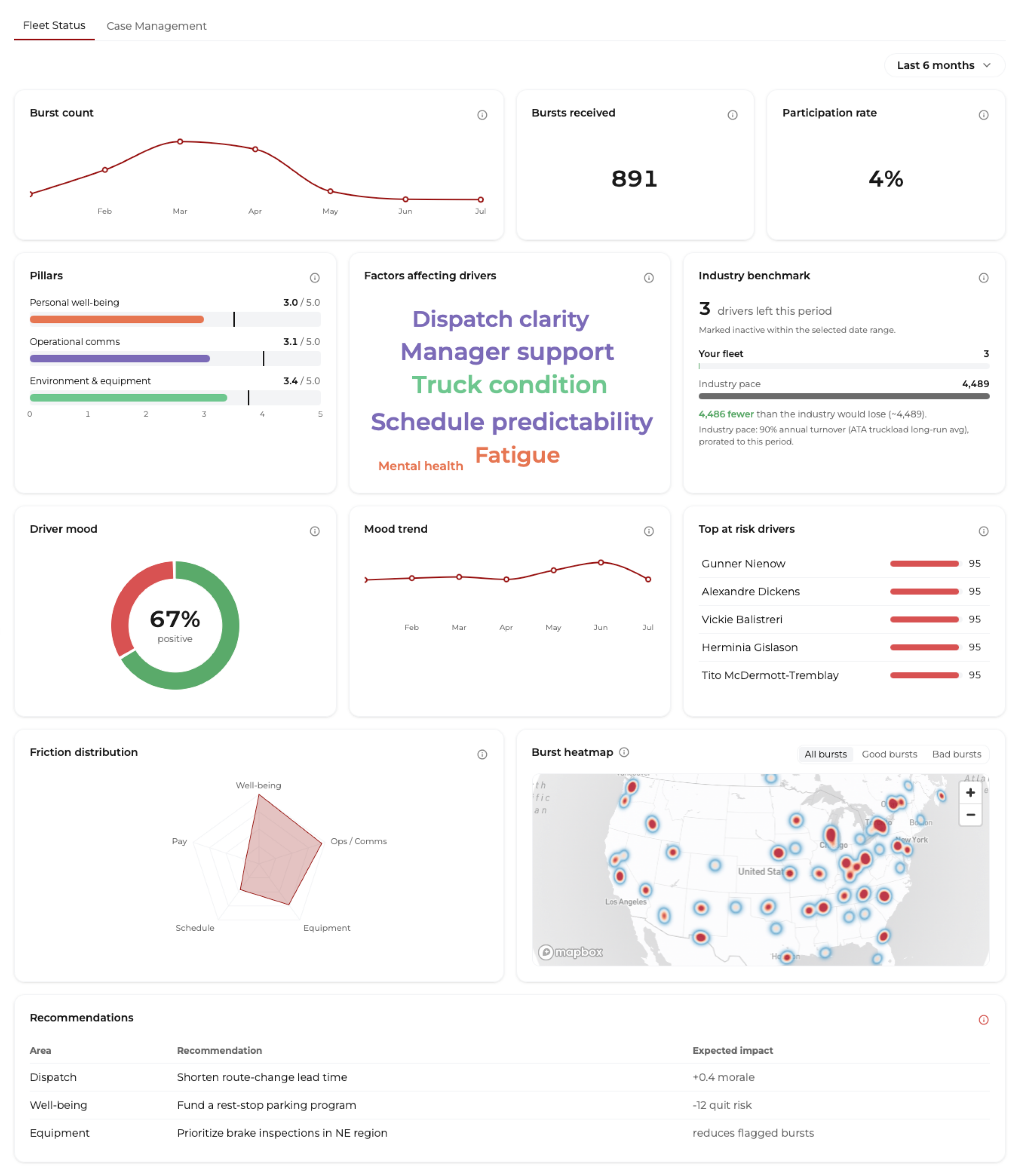
Who’s at risk this week. Which friction is showing up across drivers. How my fleet compares to industry attrition. What to do next.

Top at-risk drivers

Each driver scored against their own baseline. Quit-risk surfaced by name, not by aggregate.

Friction distribution

Pay, schedule, ops, equipment, well-being. Where the pressure is, across your fleet, in one view.

Industry benchmark

Where your fleet sits versus industry attrition, so you know whether to celebrate or act.

signals the platform monitors

Built on what drivers choose to tell you.

Road Pact analyzes the daily in-cab check-in: the engagement response, the friction tags, and the written comment. AI sentiment analysis turns that into a pattern over time, and safety-critical signals like self-harm or harm-to-others risk are flagged and routed to a designated team. The signal is what drivers choose to tell you, measured against their own baseline.

From the daily check-in

Direct driver signal

  • Daily engagement signal  Positive or negative check-in response, trended against the driver's own baseline.
  • Friction tags  Schedule predictability, dispatch clarity, pay clarity, truck condition, manager support, fatigue, parking, facilities, equipment, family time, mental health, route changes, load assignment.
  • Open comments  Optional driver-written context, in the driver's own words.
  • Response consistency  Whether a driver who used to respond every shift starts skipping. Silence is a signal.
Pattern, not single events

What the platform tracks over time

  • Directional change  Engagement trending negative over two weeks against a stable baseline.
  • Recurring friction  The same tag flagged repeatedly. Three "dispatch clarity" responses in eleven days reads differently than one.
  • Topic drop-off  A complaint that stops being mentioned because the driver has given up on it being fixed.
  • Group patterns  The same friction surfacing across multiple drivers on a route, terminal, or schedule.

A note on boundaries. Road Pact works from what drivers choose to share in the check-in: their response, tags, and comments. Sentiment and safety-risk analysis run on the driver’s own words, against their own baseline.

drills down where it matters

From fleet view to driver view in two clicks.

When a pattern surfaces, the next question is always: which driver, what pattern, how long. Every view is designed to get there fast.

 
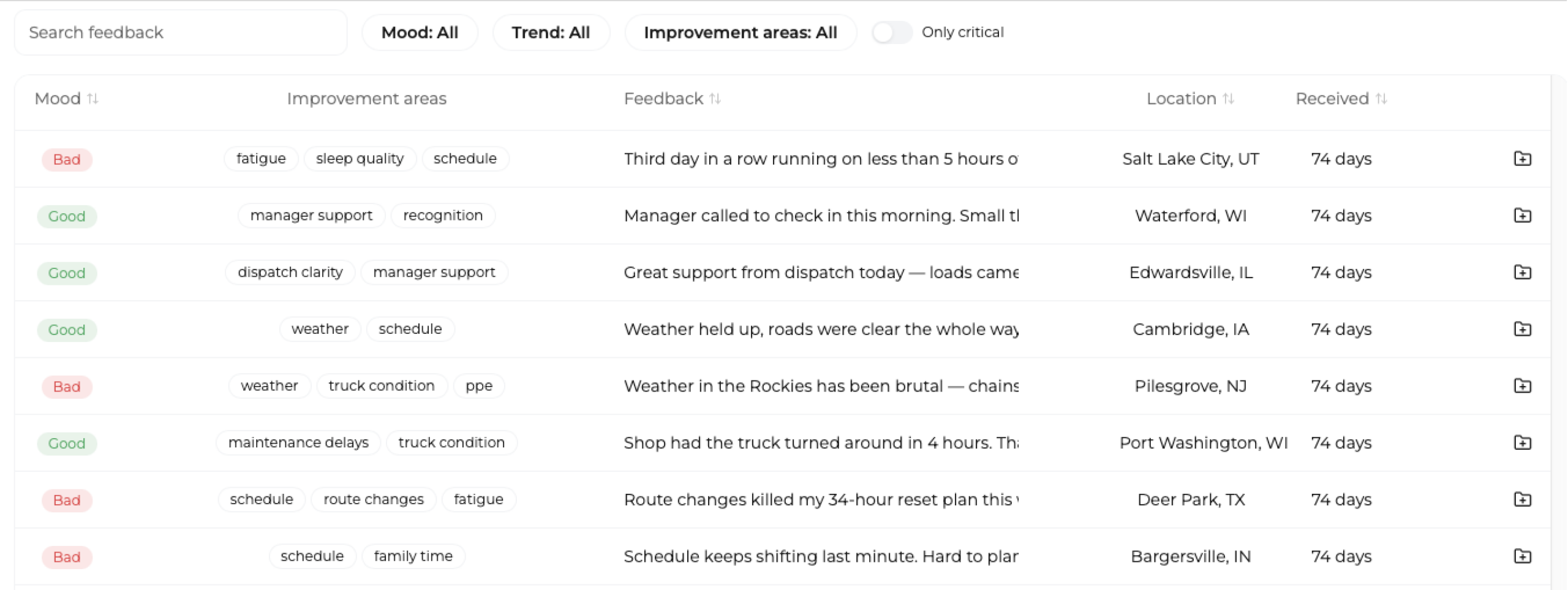
bursts

Every signal, in order.

Each “burst” is one driver check-in: an engagement signal, a location, friction tags, and an optional comment. Filter by response, location, or friction type. This is the raw signal before any aggregation.

“Schedule keeps shifting last minute. Hard to plan.” Real driver feedback, in the words drivers actually use.                           

drivers

Quit risk, per driver.

Open any driver to see their quit-risk score, mood-trend direction, and safety risk — scored against their own baseline — plus the recommended next step.

Scored by name, not buried in a CSV export.

close the loop

Every alert becomes a case someone owns.

Surfacing a pattern is only half the job. When a flagged burst crosses your severity threshold, Road Pact opens a case and routes it to the right team. Each case has an owner, a severity, and an SLA clock, and overdue actions escalate. Safety-critical signals like self-harm or harm-to-others risk route immediately to a designated alert team. Leaders see open cases, time to resolve, and workload across teams in one view.

Routed and owned

Cases open automatically from flagged bursts and route to a default team by category: safety, well-being, HR, compliance, operational, retention. Nothing sits unassigned.

On a clock, with escalation

Every severity carries an SLA. Critical, high, medium, and low cases each have a target resolution time, and overdue actions escalate so nothing goes quiet.

Closed loop, measured

Track opened versus resolved, average time to resolve, and aging. Retention work becomes accountable, not anecdotal.

Mapped to your org.

Every driver is mapped to a named manager. When the system fires an alert, it opens a case routed to the person who already owns that relationship.

Targeted check-ins

Push a specific question to a group: new hires past their 90-day mark, drivers on a problem lane, terminals running hot. Use sparingly, when the signal demands it.

Available in the Platform Science Marketplace.

Deploys through your existing mobile device management. No new hardware. No IT support required. Typically live within 2 business days of sign-off.

See the platform with our team.

A 30-minute walkthrough. We’ll show you the dashboard, the workflow, and how the platform routes alerts into cases inside your fleet’s existing manager structure. Qualified fleets may be eligible for a 30-day pilot after the walkthrough.